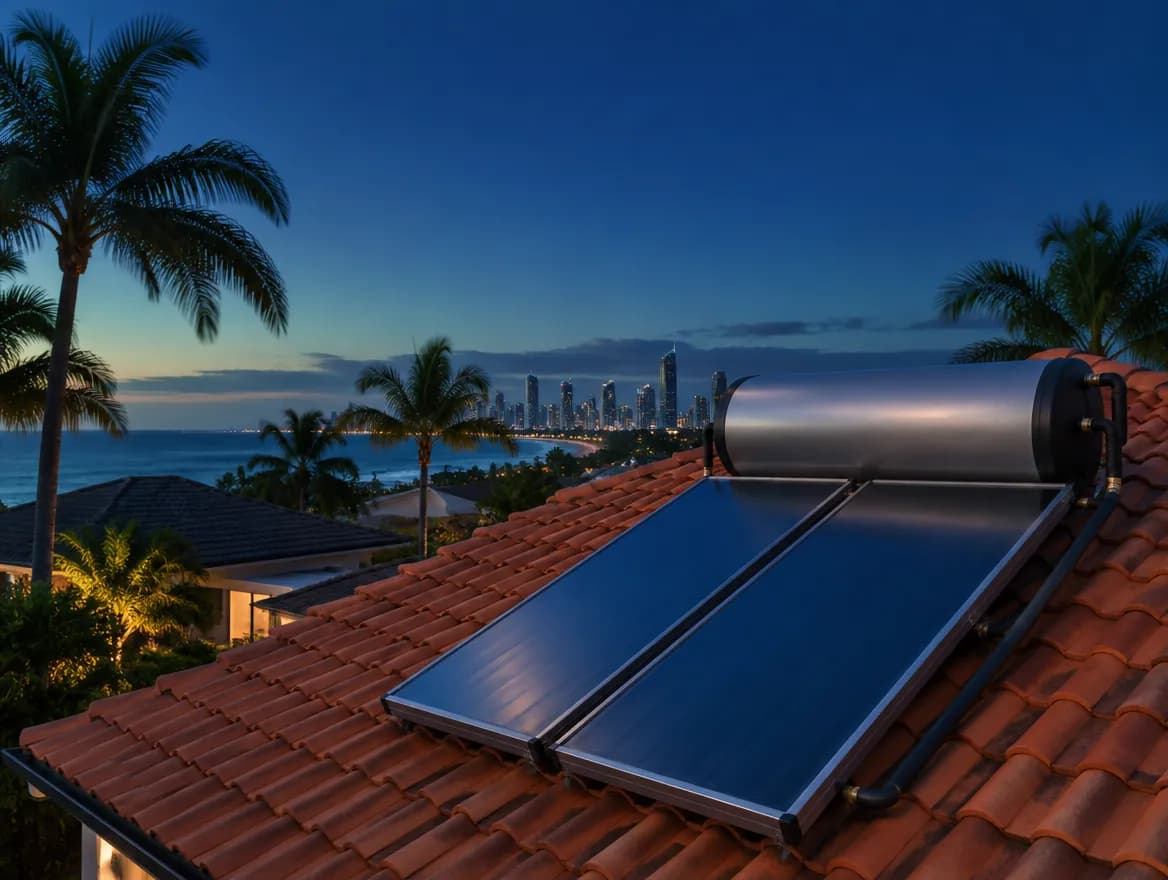
Close to the beach, salt spray settles on everything. You see it on car paint and window frames, and it's working on your roof too. For homes with solar hot water, salt air is one of the main reasons systems fail earlier than they would a few kilometres inland.
From Main Beach to Coolangatta, salt air is one of the main reasons solar systems need attention early.
What corrodes first
- Collector frames, brackets and roof fixings, especially where different metals touch.
- The outer casing of roof-mounted tanks, starting at seams, edges and the base.
- Exposed copper pipework and fittings on the roof, and the insulation around them as UV and salt break it down.
- Valves, including frost and overheat protection valves on the collectors.
- On split systems, the pump housing and controller enclosure if they're outdoors.
Corrosion where two different metals meet is a common weak point. A stainless fixing against an aluminium frame, or a copper pipe touching galvanised steel, can corrode faster in salty, damp conditions than either metal would on its own.
How far from the beach does it matter?
The effect is strongest within a few streets of the surf, on headlands and on homes facing the prevailing wind, as at Burleigh, Currumbin, Coolangatta and Main Beach. It's still present along the Broadwater and the canals. Further inland it drops off, but no part of the coastal strip is entirely free of it.
How often to check a coastal system
Most manufacturers recommend a service about every five years. For beachfront homes, checking more often is sensible, because a fixing or fitting that's corroding is cheap to replace early and expensive once it fails. A typical service covers the relief valve, the tempering valve, the anode in enamel-lined tanks, the collectors, the roof pipework and its insulation, and the fixings. From the ground, rust streaks on the roof or the tank casing are a signal to book a check.
Making a new system last near the beach
- Ask about corrosion-resistant fixings and fittings suited to coastal exposure.
- Consider placement: a split system keeps the tank on the ground, sheltered from the wind, with only the collectors on the roof.
- Keep different metals apart where they're joined, with the right isolating materials.
- Book servicing on a schedule rather than waiting for a fault.
- If the roof is very exposed, compare a heat pump in a sheltered spot. It still needs care near the beach, but it's easier to inspect and service.
We repair and service solar systems all along the coast. See plumbing on the Southern Gold Coast and solar hot water repairs.
Need help on the Gold Coast?
Tensor Plumbing is a licensed plumber and gas fitter based in Parkwood, servicing Gold Coast suburbs and the hinterland within about an hour. See solar hot water repairs on the Gold Coast and plumbing on the Southern Gold Coast, or find your suburb. When you're ready, request a quote online and attach a photo or two.
Related reading: Solar Hot Water Service: What's Checked and Why and Solar Hot Water Not Heating? Common Causes on the Gold Coast.
General information only
This article is general information about solar hot water systems in coastal conditions. It is not a substitute for a site-specific inspection by a licensed plumber, and what can be found or confirmed on any property depends on site conditions and accessible evidence.