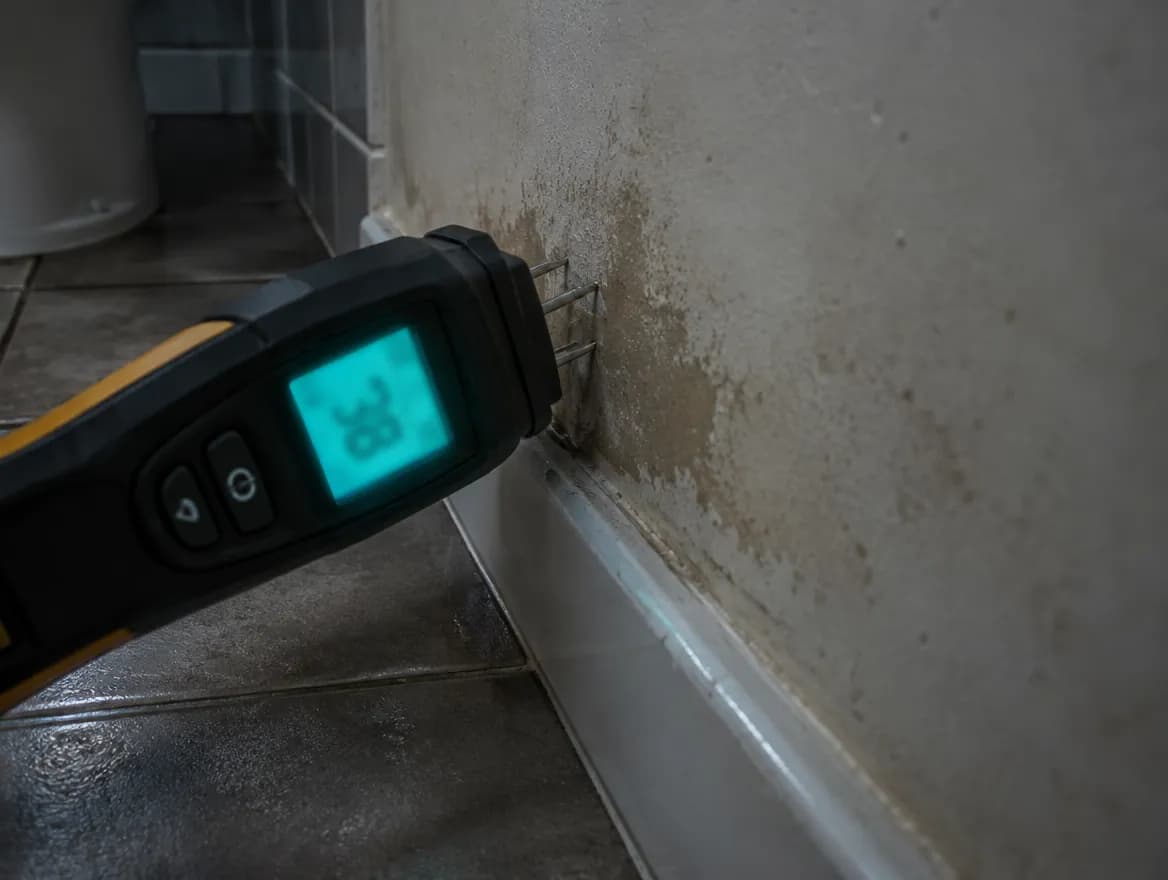
A hidden leak rarely announces itself clearly. More often it shows up as a higher water bill, a damp patch that will not dry, a musty smell in a cupboard or a meter that keeps moving when nothing is running. Because the water is inside a wall, under a slab or below the ground, the source is usually not where the symptom appears. A careful investigation works from the evidence that can be observed and measured towards the most likely location, rather than starting with guesswork and a hammer.
This is the same process we follow on Gold Coast homes and units, from slab homes in Ashmore to apartments in Southport.
This article explains the general process a licensed plumber may follow on a residential property in South East Queensland. Every site is different, so the exact steps and tools depend on the building, the pipework and what is accessible on the day.
Start with the history and the symptoms
The first part of any investigation is a conversation. When did the problem start? Has the water bill changed? Has there been recent renovation work, a hot water system replacement or a change in water pressure? Where exactly has damp or staining been noticed, and does it change with the weather or with water use in the home?
These answers help separate a plumbing leak from other common causes of moisture, such as roof or window leaks, condensation, poor ventilation or ground water. A damp wall after heavy rain may point in a different direction from a damp wall that appears only after showers are used.
Confirm that a leak exists
Before trying to find a leak, it helps to confirm that water is actually being lost from the pressurised system. The plumber will usually check the water meter with all fixtures turned off, and may isolate sections of pipework to see whether the loss stops. A pressure test, where a section of pipe is isolated and monitored for a drop over time, can indicate whether that section is holding.
- Meter observation with all known water use stopped.
- Isolation of individual fixtures, appliances and toilet cisterns to rule them out.
- Isolation of hot and cold services separately, where the layout allows.
- Pressure testing of isolated sections to see whether they hold pressure.
If the meter is stable and the pressure tests hold, the moisture may be coming from a drain, a waterproofing failure or a non-plumbing source. That is a useful finding in itself, because it changes where the investigation goes next.
Narrow down the location
Once a leak is confirmed on a particular section, the aim is to narrow down where along that section it is likely to be. A plumber may use a combination of methods, chosen to suit the site rather than applied by default on every job.
- Acoustic listening equipment, which can pick up the sound of water escaping under pressure in some conditions.
- Thermal imaging, which can show temperature patterns consistent with moisture or hot water pipework.
- Moisture meters, which measure relative moisture in building materials at specific points.
- Tracer gas, where a safe gas mixture is introduced into an isolated line and detected at the surface.
- Visual inspection of accessible areas such as subfloors, roof spaces, cabinets and access panels.
Each method has limits. Acoustic signals can be masked by traffic, pumps or soft ground. Thermal patterns can be affected by sunlight, insulation and air movement. Tracer gas depends on the gas finding a path to the surface. For this reason, findings from one method are usually cross-checked against another before any conclusion is drawn.
What the result usually looks like
A well-run investigation produces a clear account of what was observed, what was tested and what the readings were consistent with. In many cases this leads to a likely location that can be opened up and repaired with minimal disturbance. In other cases the evidence may point to an area rather than an exact point, particularly under thick slabs, behind tiles or where pipework is not accessible.
No method can guarantee a pinpoint result on every property. A responsible plumber will tell you what they were and were not able to confirm, explain the options for further investigation where appropriate, and discuss whether a repair, a reroute of the affected section or more targeted testing makes the most sense.
- Gather the history and symptoms.
- Confirm water loss and isolate the affected section.
- Use suitable methods to narrow down the likely location.
- Cross-check findings before opening up building elements.
- Record what was observed, measured and tested.
Need help on the Gold Coast?
Tensor Plumbing is a licensed plumber and gas fitter based in Parkwood, servicing Gold Coast suburbs within about 30 minutes. See water leak detection on the Gold Coast, pipe repairs and leak reports for insurance, or find your suburb. When you're ready, request a quote online and attach a photo or two.
Related reading: Thermal Imaging for Leak Detection: How It Works & Its Limits and What Should a Plumbing Report for an Insurance Claim Include.
General information only
This article is general information about hidden water leak investigations. It is not a substitute for a site-specific inspection by a licensed plumber, and what can be found or confirmed on any property depends on site conditions and accessible evidence.