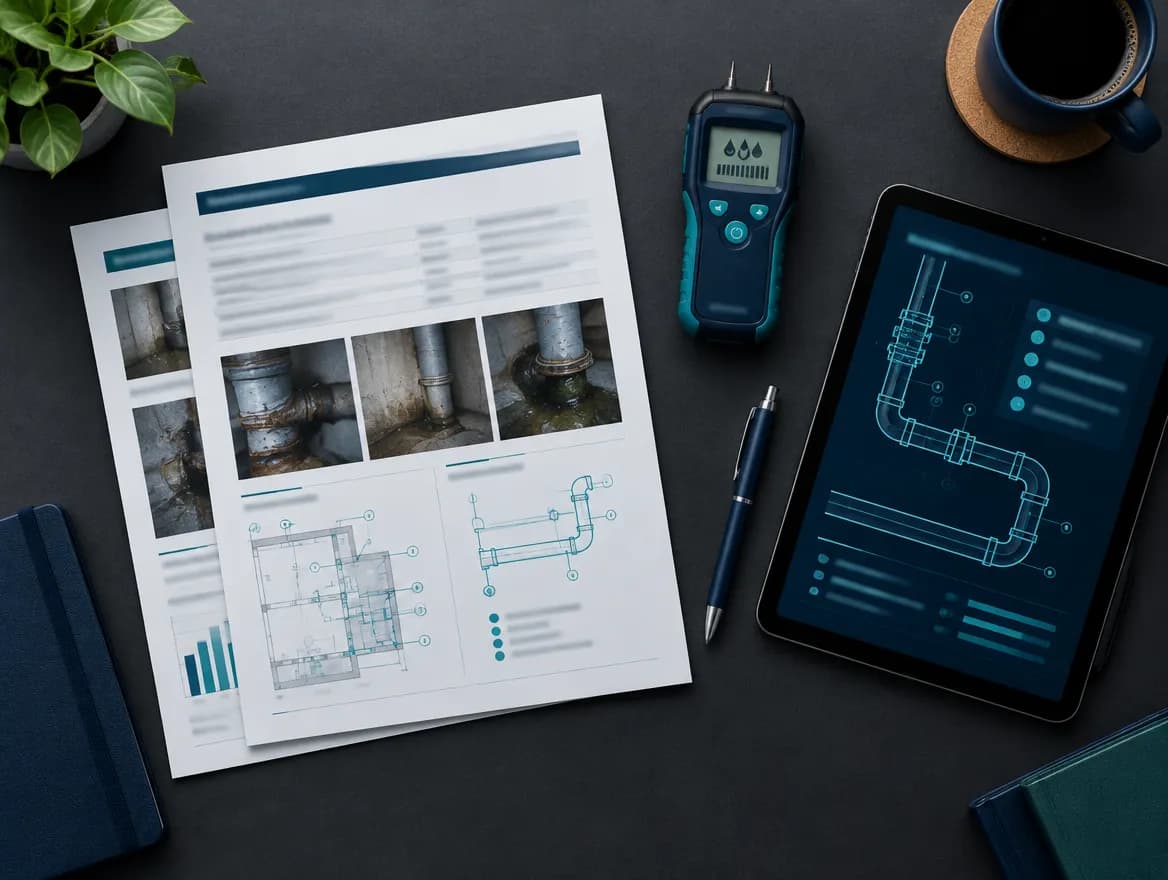
When water damage occurs, a homeowner, insurer, assessor or builder may ask for a plumbing report. The purpose of the report is to record what a licensed plumber observed, tested and found, in a way others can understand and rely on. It is not the plumber's role to decide whether a claim is covered or who is liable. Those decisions sit with the insurer and the relevant parties. A good report gives them clear technical information to work with.
Insurers and assessors on the Gold Coast and across Queensland look for the same things in a plumbing report.
Basic details and scope
A report should make it easy to understand what was inspected, when and why. At a minimum it would usually set out:
- The property address and the areas inspected.
- The date and time of the inspection, and who attended.
- Who requested the report and the reason for the inspection.
- The scope of the work, including any areas that were not inspected or not accessible.
- The name and licence details of the plumber responsible for the findings.
Being clear about scope matters. If the roof space could not be safely accessed, or a cabinet could not be removed, the reader needs to know that the findings do not cover those areas.
Methods and testing carried out
The report should describe what was actually done on site, not a generic list of equipment. That might include meter observations, isolation and pressure testing of specific sections, moisture readings, thermal imaging, acoustic listening, tracer gas or a CCTV drain inspection, depending on what was appropriate for the situation.
Where readings were taken, it helps to record what was measured and where, along with any relevant conditions. A pressure test result, for example, is more meaningful when the report notes which section was isolated and for how long it was monitored.
Observations, findings and limitations
This is the core of the report. It should separate what was directly observed or measured from what the plumber considers those observations are consistent with. Clear reports avoid overstating certainty. If the evidence points to a likely source but it was not possible to expose the pipework, the report should say the finding is consistent with that source and explain what would be needed to confirm it.
- Visible damage and its location, described in plain terms.
- Test results and readings, with locations.
- The likely source of water where evidence supports it, with the reasoning.
- Anything the plumber was not able to confirm, and why.
- Factors that may have affected the results, such as recent drying or prior repairs.
It is also helpful when the report notes any relevant history provided by the owner or occupant, clearly identified as information reported to the plumber rather than something the plumber observed directly. That keeps the evidence trail clear for anyone reading it later.
Where a duration or cause is discussed, the report should explain what evidence supports the view and acknowledge uncertainty. Statements about how long a leak has been present are often difficult to make with confidence and should be framed carefully.
Photos and recommendations
Photos make a report far easier to follow. Each image should be labelled with its location and what it shows. Thermal images should be accompanied by a normal photo of the same area so the reader can orient themselves.
Where an area of concern could not be inspected, the photos should show the reason, such as fixed joinery or an unsafe roof space, so the reader understands the limitation rather than assuming it was overlooked.
Recommendations should be practical and tied to the findings. These might include repair of a specific fitting, further investigation of an area that could not be accessed, or referral to another trade where the evidence suggests a non-plumbing cause such as waterproofing or roofing. Recommendations should not stray into coverage or liability decisions.
- Property, date, attendees and scope.
- Methods and tests actually used.
- Observations and measured results.
- Findings, stated with appropriate certainty.
- Limitations and areas not inspected.
- Labelled photos and practical recommendations.
Need help on the Gold Coast?
Tensor Plumbing is a licensed plumber and gas fitter based in Parkwood, servicing Gold Coast suburbs within about 30 minutes. See plumbing reports for insurance claims on the Gold Coast and leak detection, or find your suburb. When you're ready, request a quote online and attach a photo or two.
Related reading: Water Damage Reports: Observations vs Opinions Explained and How a Plumber Finds a Hidden Water Leak, Step by Step.
Your insurer makes the decisions
A plumbing report provides technical information. Whether a claim is accepted, and on what terms, is decided by your insurer under your policy. This article is general information and not a substitute for a site-specific inspection or advice about your policy.
Related service
Insurance plumbing reports