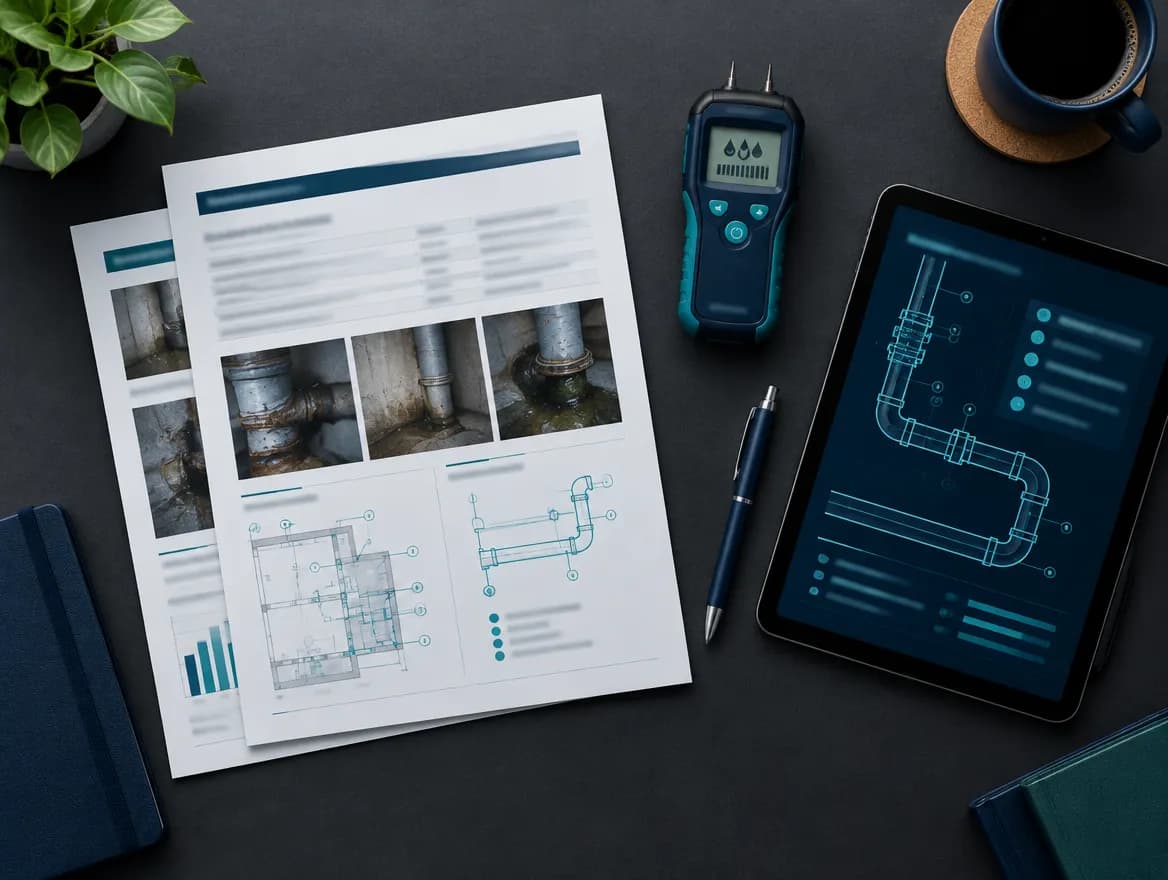
Two reports about the same water damage can read very differently. One may state that a pipe failed months ago and caused all the damage in the room. Another may say that moisture readings were elevated in a defined area, that a pressure test on the adjacent line did not hold, and that these findings are consistent with a leak from that line. The second report is less dramatic, but it is usually far more useful, because the reader can see exactly what the conclusion rests on.
Whether the claim is for a Gold Coast home or a strata building, the wording of a water damage report matters.
What counts as an observation
An observation is something the technician directly saw, measured or tested on the day. It can be checked by someone else and does not depend on interpretation. Examples include:
- Staining on a ceiling measuring roughly a stated size, in a stated location.
- Moisture meter readings at specific points, compared with a dry reference area.
- The water meter low-flow indicator moving with all fixtures isolated.
- A pressure test on the cold water line to the ensuite dropping over the monitoring period.
- Visible corrosion on a fitting exposed during the inspection.
Good reports record observations precisely and in plain language, with photos and locations so the reader can follow along.
What counts as a professional opinion
An opinion is the technician's interpretation of what the observations mean. It draws on training and experience, and it is often exactly what the reader needs. The issue is not whether opinions are included, but whether they are clearly identified as opinions and supported by the evidence.
Typical opinions in a plumbing report might cover the likely source of water, whether the damage pattern is consistent with a slow leak or a sudden event, or whether further investigation is warranted. Each of these should be tied back to specific observations, and each should carry an appropriate level of certainty.
Language that signals the right level of certainty
Careful wording is not hedging for its own sake. It tells the reader how firmly a finding is established. Common phrases in technical reports include:
- Observed or measured, for things directly seen or recorded.
- Tested, for results of a specific procedure such as a pressure test.
- Consistent with, where evidence supports a conclusion but does not prove it.
- Not able to confirm, where evidence was insufficient or areas were inaccessible.
- May, where a possibility exists but has not been established.
Statements about timing deserve particular care. It is often not possible to say with confidence how long a leak has been present from a single visit. Where a report comments on duration, it should explain what the view is based on, such as the type of staining, material condition or history provided, and acknowledge the limits.
Why the distinction matters to everyone involved
Insurers, assessors, builders and owners all read reports for different reasons. A clear separation between observation and opinion helps each of them use the information appropriately. It also makes it easier to resolve disagreements, because parties can see whether they differ on the facts or on the interpretation.
Consider a simple example. A report that says a ceiling stain was observed beneath the ensuite, moisture readings were elevated in that area, and a pressure test on the ensuite cold line did not hold, gives the reader a clear chain of evidence. A conclusion that the damage is consistent with a leak on that line follows naturally, and anyone reviewing the report can see how it was reached and what further steps, such as exposing the pipework, would confirm it.
It is also important that a plumbing report stays within its technical lane. A plumber can describe the plumbing evidence and give an opinion on likely source. Whether that outcome is covered, and who may be responsible, are decisions for the insurer and other parties, not for the report writer.
- Record observations precisely, with locations and photos.
- Identify opinions as opinions and link them to the evidence.
- Use wording that reflects the actual level of certainty.
- State limitations and inaccessible areas openly.
- Leave coverage and liability decisions to the appropriate parties.
Need help on the Gold Coast?
Tensor Plumbing is a licensed plumber and gas fitter based in Parkwood, servicing Gold Coast suburbs within about 30 minutes. See water damage reports on the Gold Coast and leak investigations, or find your suburb. When you're ready, request a quote online and attach a photo or two.
Related reading: What Should a Plumbing Report for an Insurance Claim Include.
General information only
This article is general information about how technical reports describe water damage. It is not a substitute for a site-specific inspection by a licensed plumber, and what can be found or confirmed on any property depends on site conditions and accessible evidence.
Related service
Insurance plumbing reports